
Why is my hp printer printing blank pages? The standard answers are not enough
Every week someone stands next to a printer holding a sheet that looks completely unused. The screen says ready. The cartridge was changed. The paper went in, and blank paper came out. If that is you, you have probably typed why is my hp printer printing blank pages. The panic is not limited to one brand.
Before we go too far, a quick sample limitation. I work on the quality side of a print operation. I review every deliverable before it reaches customers, roughly 180 jobs a quarter. I rejected maybe seven percent of first deliveries in 2024 because something was off spec. If you are troubleshooting a massive production floor, this advice might be too basic. For ordinary office and small commercial workflows, it should be useful.
The standard advice covers ink levels, clogged nozzles, paper size, and drivers. That advice is not wrong. It is incomplete, because it treats each blank page as a one-off event. When blank pages come back three times a month, the printer is not the whole story. The system around it has a gap.
The deeper problem: spec mismatch, not bad luck
It is tempting to think that an inkjet printer is a simple box that takes digital data and puts toner or ink on paper. Actually, an inkjet is a small precision fluid dispenser. Its printhead has nozzles that are measured in microns. The ink formula has to match the printhead. The printer driver has to match the paper. The paper has to match the job. There is no room for maybe.
That is why I do not like the advice that says one universal printer can handle everything. That idea comes from an era when office printing mostly meant black text on plain paper. Today the same machine is expected to print labels, coated media, double-sided proposals, and sometimes fine-art giclee prints. Those jobs put very different demands on the printhead.
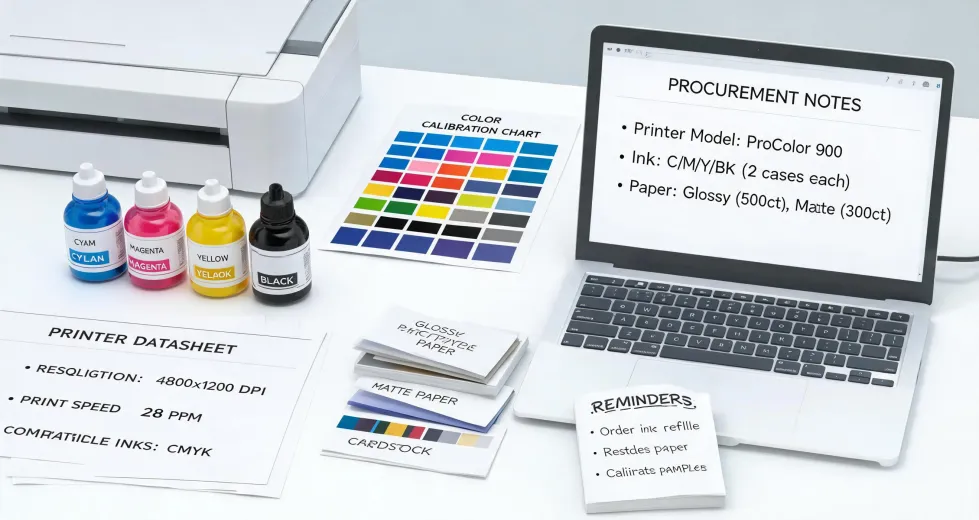
The question epson 522 ink for what printer is a good example. The 522 code is an EcoTank bottle code, and the exact list of Epson models that take it is printed on the official compatibility page. I am not going to type a list from memory, because I have seen too many online lists get copied wrong. The better quality habit is to start with the printer model that is printed near the tank door. If the official spec says 522, use 522. If it does not, the bottle is not the right material for that printhead. Beginning with the ink is buying supplies before you have defined the machine.
Wireless makes the problem harder to see
A wireless printer adds network distance between intention and paper. You hit print, the queue says complete, and the page comes out blank or never comes out at all. When I look at a wireless printer issue, I do not stand at the paper tray first. I check whether the job arrived on the right printer and whether the correct driver is selected. If a stale driver sends plain paper settings while the media tray holds glossy label stock, the output can look like a printer fault when it is actually a configuration fault.
Sticky notes are a symptom
I know a print operation is running on hope when a cluster of sticky notes appears next to the printer. Sticky notes saying use 522 ink for the Epson on the right, or do not feed that thick stock from the main tray, or check the giclee proof before telling the artist it is ready. The sticky notes are not the problem. They are a visible shortcut for a missing spec sheet. They work until someone removes a sticky note to use the desk for something else, and the next run becomes a problem. Blank paper is often just the point where undocumented knowledge stopped being shared.
What a blank page actually costs you
A single blank page from a desk printer costs pennies. But a blank page in a production run is a different story. It costs labor, paper, time, and sometimes customer trust. In a fine-art print workflow, a blank proof on premium media is expensive in both material and mood. In a label job, a blank label means one more unit that cannot go out. The cost of the investigation is usually higher than the cost of the paper.
Some of the worst failures I have seen began with unverified compatible supplies. I am not against independent ink brands. I am against the word equivalent without evidence. In the United States, FTC advertising guidance says that claims need to be truthful and substantiated. If a supply vendor says their ink is just like the original, I ask for the technical data. Compatible should mean tested, not only shaped to fit.
There is another layer in quality work. If you do not test at defined intervals, you are accepting the mystery. A quick nozzle check once a week is a small task. It catches the problem before the client does.
The fix is shorter than you expect
If you are in the why is my hp printer printing blank pages situation at this exact moment, start with the printer diagnostic. Print the nozzle check or head quality page. If the page is blank, run one cleaning cycle, wait, and print it again. If the second check is still blank, stop playing guess the problem and call the manufacturer support. In many inkjet cases, endless cleaning cycles waste ink and make a minor issue worse.
Once the printer is producing output again, write down three facts and put them where people can see them. The exact model number. The ink or maintenance part number from the manual. The list of approved paper types for the job you normally run. That short line is the permanent replacement for sticky notes. It is less colorful, but it survives staff changes and messy desks.
If you are shopping instead of troubleshooting, choose the printer family for the job, not just for the logo. An Epson printer can be the right answer for documents, labels, or fine art, but rarely is one Epson printer the right answer for all three. For high-volume office document printing, the Epson EcoTank line is usually the practical answer because the running cost per page is low. For color-critical fine-art work, a true epson giclee printer with pigment ink and color management is the right tool. For a team that prints from laptops all over the building, a wireless printer with clear queue names and a documented driver policy will reduce a lot of blank page panic.
I wish I could tell you that one printer is perfect for everything, but I have not found one. The same honesty applies to this advice. My experience is mostly built on 200-ish print jobs per quarter. If your context is completely different, use the manufacturer support channel and your own quality data. But if I had to reduce this to one sentence, it would be this: blank pages are rarely about bad luck. They are about a spec that someone did not write down.
There is something satisfying about a clean nozzle check after a week of blank output. The test page comes out with all its stripes, and the problem disappears. That is the moment you realize the fix was not magic. It was giving the printer the right definition of what good looks like.
