
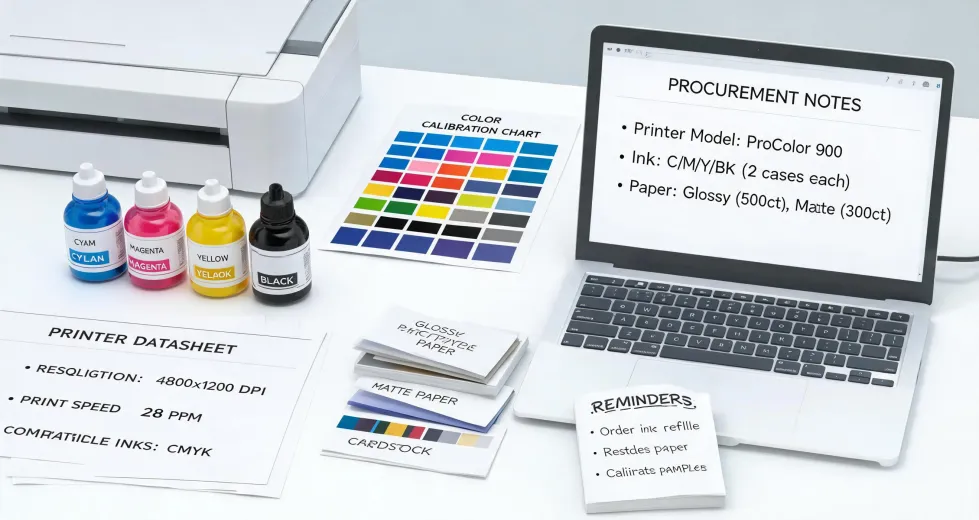
I'm the person who signs off on office equipment purchases for a 140-person B2B services firm. I've managed our office budget for nine years, worked with 28 vendors, and tracked every printer invoice in our procurement system. So when I read Epson all-in-one printer reviews, I don't start with star ratings. I look for costs that show up eighteen months later.
The comparison that matters most to me isn't Epson versus another brand. It's Epson EcoTank all-in-one versus a cartridge-based Epson WorkForce all-in-one. Same manufacturer, two different consumable systems, two very different lifetime costs.
What I Actually Compare in an Epson All-in-One Review
Most buyers focus on the price of the machine and completely miss the costs that follow it. I compare four dimensions: real cost per page, output quality for client-facing work, maintenance risk, and workflow fit.
When I audited our 2023 office spending, about a third of print-related costs were not printer purchases. They were emergency ink, service calls, and reprints. That pattern changed how I buy. Our procurement policy now requires quotes from at least three dealers and a simple total-cost sheet before I recommend any Epson printer.
Cost Per Page: What a Mean Calculator Won't Show
The common question is which Epson printer should I buy. The better question is how many pages the office actually prints. If you use a mean calculator on our 2024 data—total ink and supplies divided by total pages—the difference stands out.
One branch used a cartridge WorkForce WF-2860 and printed 31,200 pages with $4,180 in ink. Another branch used an EcoTank ET-2850 and printed 29,800 pages with $830 in ink. A mean calculator says the EcoTank was roughly $3,350 cheaper in supplies. That number is real, and it explains why many Epson all-in-one printer reviews recommend tank models.
But the surprising part is which machine I would buy for a very low-volume office. If you print 300 pages per month and mostly use scan or copy functions, the cartridge-based model can be the lower total cost. The upfront price is usually lower, and you don't get stuck with a large bottle inventory or a machine that needs frequent use to keep nozzles healthy. High cost per page only matters when you print enough pages. The mean hides that distribution.
Output Quality Is a Budget Item, Not a Luxury
I have mixed feelings about quality conversations because budget constraints are real. But output quality affects how clients see the company. A printed proposal is often the first physical thing a prospect sees. If a chart has a faded band or colors look off, the work behind it gets judged as less professional.
That's why the cheapest consumable is not always the best business decision. The question is what the page is for. For internal drafts, almost any Epson all-in-one can be fine. For client-facing deliverables, I factor in paper, printhead condition, and ink behavior before choosing a model. A difference of a few cents per page is not a luxury; it is a risk control expense.
In my experience the EcoTank produces rich color on plain paper for presentation decks and proposals. The cartridge WorkForce line, when using pigment ink, is the better pick whenever documents need to survive highlighter or moisture. There is no single quality winner because the work is different.
Dealing With the Epson Printer Vertical Lines Problem
If you search for Epson printer vertical lines problem, the fix is often less dramatic than people fear. Most repeated vertical streaks or faint lines come from a printhead nozzle issue. The first diagnostic step is a nozzle check, not a new printer. The nozzle check prints a pattern that shows whether all colors are firing. If one color is broken, I run the printer's cleaning utility once, wait the recommended time, and print the check again.
I don't recommend running cleaning five times in a row. That just wastes ink and can make the problem worse by pulling air into the system. If cleaning doesn't clear the line, check ink levels, refill the tank correctly, and look for air bubbles. Many vertical line complaints are caused by an empty tank, not expensive hardware damage.
This issue has a real cost. According to USPS pricing effective January 2025 (source: usps.com/stamps), a First-Class Mail letter costs $0.73, and a large envelope costs $1.50. When a flawed document goes out, you lose the paper, the ink, the labor, and the postage on the first attempt. That's why our weekly maintenance list begins with a nozzle check for every active Epson printer.
Both the EcoTank and the cartridge WorkForce can develop vertical line problems if they sit unused. The difference is maintenance economics. On the cartridge model, a nozzle check pattern consumes a tiny amount of ink, and a cleaning cycle may consume a noticeable amount. If the issue comes from poor ink flow, the cost of consumables becomes obvious. On the EcoTank, the ink is cheaper, but the need to find the real cause is no lower. A clogged printhead can reduce the life of the printer either way.
Workflow Fit: Ink Habits, Desk Converters, and Printer Placement
Printer reviews read as if the device sits alone in a room. It doesn't. The people who use it bring habits from previous equipment. If someone learned how to change ink in HP printer, they expect cartridge replacement to be a basic procedure. That skill is useful for cartridge-based Epson, but with an EcoTank model the routine is different. You fill a tank from a bottle, run initial charging, and monitor ink levels in the tank. It's not harder, but it is different, and a fifteen-minute training session prevents expensive mistakes.
Here's another overlooked variable: the desk around the printer. We bought standing desk converters for part of our office last year, and the new arrangement made us rethink where a printer could sit. A standing desk converter is not a printer accessory, but it changed the available surfaces and noise expectations in the room. It also reinforced the cost lesson I give to every department: a one-time expense like a standing desk converter is easy to compare at purchase, but a printer creates ongoing supply and maintenance costs that don't appear on the same receipt.
Which All-In-One Would I Buy?
The answer depends on page volume, not on which printer has the better press release.
Choose an EcoTank all-in-one when your office prints at least fifteen hundred to two thousand pages per month, needs color regularly, and can assign one responsible person to check nozzles. That's where lower running costs compound into real budget savings.
Choose a cartridge-based Epson all-in-one when print volume is low, when the upfront price is the hard constraint, or when pigment ink durability is necessary for the documents you send.
And if the issue is the Epson printer vertical lines problem, don't start by comparing new models. Run a nozzle check first. Too often the real fix is a cleaning routine, not a purchase order.
