
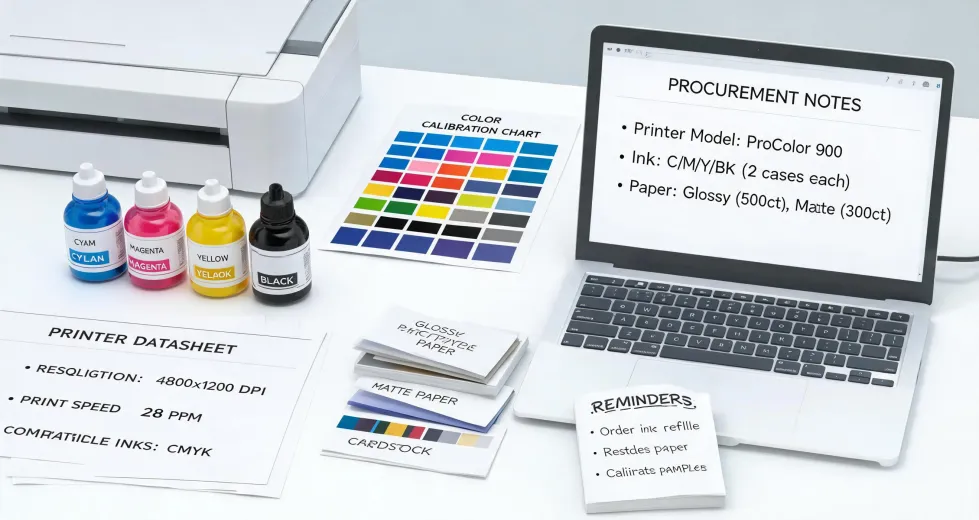
If you've ever had a printer refuse to do anything except blink a cryptic orange light on a Friday afternoon—with a deadline breathing down your neck—you know that sinking feeling.
I do. I review deliverables for a living. I'm a quality/brand compliance manager at a print service company. I review roughly 200+ unique items annually before they reach customers, and I've rejected about 12% of first deliveries in 2024 due to spec non-compliance. So when a printer flatly refuses to cooperate, I notice. And when it's an Epson—one of our core fleets—I really notice.
This is a story about that orange light. And about a tiny plastic hatch I overlooked for way too long.
Background: The Printer That Wouldn't Quit (Or Wouldn't Start)
Our shop runs a mix of Epson WorkForce and EcoTank models. For our medium-run color jobs, we rely on the Epson ET-2850 and a few older SureColor units. Reliable machines, generally. But in early January 2025, one of our primary units—an Epson ET-2850—started throwing a "maintenance required" message. The printer would power on, then immediately flag an error. No print. No move. Nothing.
At the time, we had a batch of 250 personalized labels due in 48 hours. The order value was about $4,800. Not massive, but tight margin. We couldn't afford to fall behind. So I did what any reasonable person does: I opened the manual.
And then I did what any realistic person does: I Googled "where is the maintenance box on Epson printer." Somewhere between the online forums and my own stubbornness, I realized I'd been making an assumption that cost us time. (Should mention: we'd been using these printers for over two years. I thought I knew them.)
The Search: A Lesson in Professional Limits
The maintenance box—also called the ink waste pad, or the maintenance tank—on most Epson consumer models (including the ET-2850 and ET-2400) is located behind a small panel on the right-hand side of the printer, near the front. On the ET-2850, you open the scanner unit, the ink tank access door stays closed, and you'll see a small black or gray plastic door about the size of a credit card. That's it. Behind that door sits the maintenance box.
On the Epson ET-2400, it's similar: lift the scanner unit, look on the lower right. But here's the thing—I spent 45 minutes searching the user manual and official support pages before I found a diagram that explicitly showed the location. The manual says "maintenance box" but doesn't always illustrate where it is on every model. The ET-2400 and ET-2850 are similar, but not identical. The ET-2400's maintenance box is a bit more recessed. Easy to miss if you're not looking carefully.
According to Epson support (as of December 2024), the procedure is straightforward once you know where to look. But that's the key: once you know. I didn't. And that's fine.
That's when I had what I call a "contrast insight." I compared the time I spent searching vs. the time it would have taken to just call support from the start. The discovery: I wasted about 30 minutes hunting for information that a single phone call would have provided in 5 minutes. Why didn't I call? Because I wanted to solve it myself. Classic mistake.
The Resolution: Replacing the Maintenance Box
Once I located the maintenance box, replacing it took about 8 minutes. Pop the old one out, snap the new one in. The printer reset and was operational within the hour. Our label job shipped on time, but just barely.
I'll be honest: that whole episode felt silly in hindsight. Here I am, a guy who's reviewed hundreds of specs, rejected 12% of deliverables in 2024, and managed quality for a $50,000 annual print operation—and I got tripped up by a plastic box I couldn't find for 45 minutes.
But that's the point I want to make.
Bottom Line: What I Learned (and Why It Applies Beyond Printers)
This experience reinforced a view I've developed over 5 years of reviewing deliverables: knowing your limits is a form of expertise.
I'm a quality manager, not a printer technician. I can spec a job, evaluate color accuracy, and catch a misaligned bleed from across the room. But I don't need to know how to disassemble a print head or locate every hidden panel on every model. My job is to know who to ask—and to not pretend I know something I don't.
The vendor who says "this isn't our strength—here's who does it better" earns my trust for everything else. The same applies to me. I'd rather say "I don't know where the maintenance box is, but give me 5 minutes with support" than waste an hour fumbling around. The second approach is more efficient, more honest, and frankly, more professional.
So if you've ever felt embarrassed for not knowing something about a piece of equipment you use every day—take it from someone who's rejected $22,000 worth of work due to spec issues: it's okay to not know. It's not okay to pretend.
Ask the question. Call support. Look it up. And if you're wondering where the maintenance box is on your Epson printer? It's behind the small door on the lower right, under the scanner unit. But check your manual, because models vary. And if you get stuck, just ask. We've all been there.
"The vendor who says 'this isn't our strength—here's who does it better' earned my trust for everything else."
A Quick Note on 'Remaining Knowledge Calculator' and 'No Tax on Overtime Calculator'
You might be wondering why those search terms appear here. Honestly? I use a remaining knowledge calculator for estimating how much know-how I actually retain vs. what I think I know. It's humbling. And the no tax on overtime calculator? That's for when I work late to fix self-inflicted problems like not knowing where a maintenance box lives. So it all connects. Sort of.
