
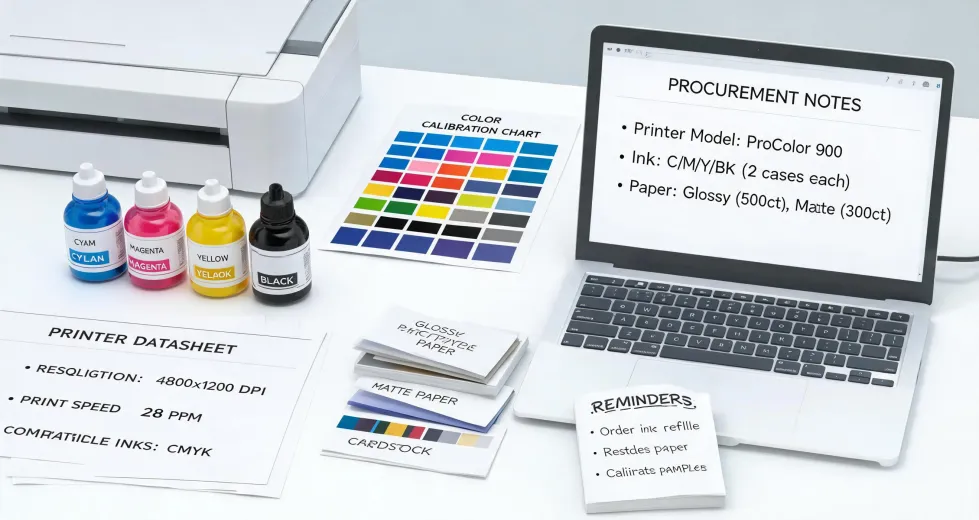
I review print work before it ships. That's my job. For the past four years, I've been the quality and brand compliance person at a printing company, and I look at roughly 200+ unique items annually—brochures, labels, color proofs, and custom jobs where a client's logo has to match a specific Pantone chip. In Q1 2024, I rejected 12% of first deliveries because of color consistency and setup issues. Most of those issues had nothing to do with the printer itself.
So when someone asks me about an Epson ET-2803 printer driver download, I get it. You unbox a printer, it won't talk to your laptop, and you search for help. The driver is real, and if it's wrong, nothing works. But I've learned that the driver is only the beginning. The harder problem shows up later, when the ink runs out and the colors start drifting.
The problem you think you have
The surface problem looks simple: the printer isn't connecting, or it's printing streaky pages, so you search for how to install printer drivers. If you have an Epson ET-2803, the standard path works—go to the official Epson site, find the driver for your operating system, install it, and restart the printer. That usually solves the connection issue.
But the driver is not just a translator. It also controls color management, ink usage, and paper feed behavior. Install the wrong version, and the printer might still print. It just won't print the way it was designed to. That's why I treat the Epson ET-2803 printer driver download as a quality checkpoint, not a one-time fix.
The deeper problem: ink compatibility
Most buyers focus on the printer price and completely miss the compatibility requirements. The question everyone asks is, which Epson printer is the best bargain? The question they should ask is, what does it actually take to keep this thing producing consistent output?
Ink is where consistency lives. An Epson printer ink compatibility chart exists for a reason: the printhead, the ink chemistry, and the driver all have to agree. For an EcoTank model like the ET-2803, the ink system is completely different from cartridge-based models. The bottles look similar, but the pigment, dye, and viscosity are tuned for specific printheads. Put the wrong one in, and you'll find out why the chart exists.
When I compared two ET-2803 setups side by side—one with the proper Epson ink and an official driver, one with a cheaper alternative and a generic driver—I finally understood why the details matter. The first setup held color across 50 prints. The second drifted noticeably within 10.
I'm not saying every third-party ink is bad. I'm saying compatibility cannot be assumed. The official chart is not a suggestion. It's a map of what the printer was designed to handle. If you buy ink that's outside that map, you're not saving money. You're becoming the test lab.
Drivers matter the same way. A driver is part of the quality chain. It tells the printer how much ink to lay down, how to handle paper thickness, and how to convert the colors on your screen into dots on the page. That's why the driver should come from the manufacturer, not from a pop-up ad promising to fix all your printer problems.
When I implemented our verification protocol in 2022, the first thing I did was ban automatic driver update tools on our production PCs. It felt harsh, but the results were immediate. Our reject rate dropped by about a third. The cause wasn't the printheads. It was computers swapping the correct driver for a generic one without anyone noticing.
The cost of getting this wrong
In my job, I track defects using a weighted average calculator rather than a simple average. Here's why: a misprint on an internal memo is annoying. A misprint on a client-facing brochure is expensive. If you average them together, the expensive one hides behind the cheap one. A weighted calculation forces you to see which errors actually cost money.
I still wear a calculator watch on the shop floor because I like being able to punch in numbers without pulling out my phone. It's a habit from college. When I see a print run with an odd failure pattern, I do not trust my gut—I calculate. The numbers usually point to one of three things: the ink was wrong for the printhead, the driver was the wrong version, or the paper was not compatible.
Paper is another blind spot. People blame the printer when the real issue is the paper. The same ink and driver that work perfectly on Epson glossy paper can look terrible on absorbent plain paper. Commercial print is generally expected to hold about 300 DPI at final size. For brand-critical colors, the standard is tighter:
Industry standard color tolerance is Delta E below 2 for brand-critical colors. Above that, trained observers can see the difference. Reference: Pantone Color Matching System guidelines.
I remember one project where the blue on the approved proof was visibly off. I want to say we rejected about 8,000 sheets—don't quote me on the exact number, it might have been 7,500—but the cost was real. The vendor said it was within industry standard. Our standard was stricter. That rejected batch became a $22,000 redo and delayed the client's launch. Since then, every contract we sign includes the phrase verify ink and driver compatibility before production.
The transparent path
I've learned to ask what's NOT included before I ask what's the price. That applies to printers too. A printer might look affordable, but the total cost includes the right ink, the right driver setup, and the time to verify the output is consistent. Setup fees, shipping, proof revisions, rush charges—those are the places where a low quote becomes a high invoice. The vendor who lists all requirements upfront—even if it makes the setup look longer—usually costs less in the end.
The best driver install is the boring one. You download it, you install it, you test a print, and you move on. If you're spending hours on forums trying to fix a brand-new printer, something upstream is wrong—probably the ink, the paper, or a driver that didn't come from the manufacturer.
So if you're dealing with a new Epson printer, here's my short and slightly boring advice:
- Search for the Epson ET-2803 printer driver download, but only on Epson's official site.
- Find the Epson printer ink compatibility chart before you buy any ink, not after.
- Run a test print with the exact paper you plan to use for the actual job.
- Calculate the real cost per page using a weighted average calculator, not just the sticker price of the ink.
- If the output looks wrong, change one variable at a time—ink, driver, paper—and test again.
The printer is not the problem. The problem is everything you attach to it. Get that part right, and the machine will do exactly what it's supposed to.
