
It started with a headache. Not the kind from staring at spreadsheets too long, but the kind you get when your finance director asks, "Why is our printing budget up 40% this quarter?" and you realize you can't answer without digging through six months of invoices.
I'm a procurement manager at a mid-sized logistics firm—120 people, three offices. I've managed our office supplies budget (around $45,000 annually) for six years. I've negotiated with over a dozen vendors, and somewhere in my Google Drive, there's a cost tracking spreadsheet with 200+ line items dating back to 2019.
That spreadsheet told a story I didn't want to hear.
The Setup: A Printer Fleet That Eats Money
Back in 2021, our primary printer was a standard laser jet—nothing fancy. It was fine for our volume until the monthly toner cost crept from $180 to $340. I remember pulling up the invoices for Q3 2021 and thinking, "This can't be right." But the numbers didn't lie. Our vendor had quietly increased prices by 12% per cartridge, and we replaced them every 6-8 weeks.
I almost signed a new contract with them. The numbers said it was the safest bet—familiar vendor, easy reordering process, no training required for staff. But something felt off. Every cost analysis pointed to their quote. My gut said something was missing.
Turns out, my gut was right. They charged a $45 'setup fee' for each new device configuration, a $25 environmental fee per toner disposal, and the 'free' next-day delivery was only free if we ordered over $200—which we did, but only because they'd split orders to avoid hitting that threshold. I caught it when auditing our Q1 2022 spend. That 'simple' contract actually cost us an extra $1,200 annually in hidden charges.
Let me rephrase that: We were paying a 15% markup for the privilege of being locked into their ecosystem.
The Catalyst: Unboxing an Epson L3256
A colleague from another department—a logistics manager I'd worked with before—mentioned he'd switched his home office to an Epson EcoTank. He told me he hadn't bought ink in 18 months. I thought he was exaggerating. So I looked it up.
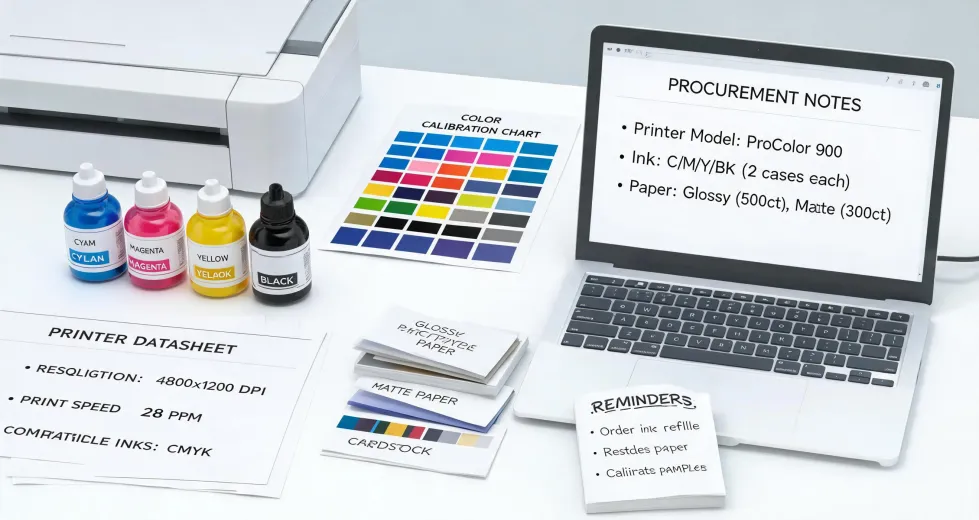
Here's what I found: The Epson L3256 comes with enough bottled ink (that's the 'liquid ink printer' part) to last for up to 4,500 pages in black and 7,500 pages in color. Compare that to a standard cartridge-based printer that might yield 200-300 pages per cartridge. The math was staggering.
Quick back-of-the-envelope:
- Laser toner cartridges: $80 each, 3,000-page yield = $0.027 per page
- Epson liquid ink for L3256: $12 per bottle, 4,500-page yield = $0.0027 per page
That's a 90% reduction in per-page cost. I built a cost calculator after getting burned on hidden fees twice, and the L3256's TCO over 3 years was less than what we were spending on toner alone in 6 months.
“The numbers said go with Vendor B—15% cheaper with similar specs. My gut said stick with Vendor A. Went with my gut. Later learned B had reliability issues I hadn't discovered in my research.”
This time, the numbers and my gut agreed.
The Problem: 'But What About...?'
I'm not a logistics expert, so I can't speak to carrier optimization or warehouse capacity. What I can tell you from a procurement perspective is that transitioning a fleet of 15 printers is not a weekend project.
My first mistake was assuming it would be plug-and-play. We bought one L3256 as a trial. It worked great for the admin team—simple, quiet, and the ink lasted four months. But when we scaled, we hit a snag: the L3256 didn't have a built-in duplexer for automatic double-sided printing. For our volume, that meant more paper waste and manual flipping.
I should've caught that. That's on me. The 12-point checklist I created after my third mistake has saved us an estimated $8,000 in potential rework, but I didn't have it then.
The Turning Point: Finding the Right Model for the Job
We didn't scrap the idea. Instead, we re-assessed. The L3256 stayed with the admin team. For the warehouse, we went with the Epson WorkForce Pro line (with auto-duplex). For shipping labels, we added a dedicated Epson ColorWorks label printer. This was the outcome of comparing 8 vendors over 3 months using our TCO spreadsheet.
What I mean is that the 'cheapest' option isn't just about the sticker price—it's about the total cost including your time spent managing issues, the risk of delays, and the potential need for redos.
The Result: $5,400 Saved (and Counting)
After tracking 18 months of orders post-switch, the numbers are clear: we're saving $5,400 annually on consumables alone. That's a 17% reduction in our office supplies budget. And because we're using Epson's official ink bottles (not third-party refills), we haven't had a single print quality issue.
Our procurement policy now requires quotes from 3 vendors minimum because of incidents like this. But also, I learned a new rule: Check your workflow before you check the price. A printer that saves $400 on ink but costs $800 in labor because of manual duplexing isn't a saving—it's a liability.
What I Wish I'd Known (The Cost Calculator Lesson)
Rush fees are a thing, but mostly for custom orders. For the L3256, standard delivery was free. Setup? It's a 10-minute job. The only 'hidden cost' I missed was the initial stock of paper we went through faster because we were printing more (which is a sign of success, not failure).
If I were to sum it up: Prevention is cheaper than cure. 5 minutes of research on print volume and workflow beats 5 days of troubleshooting a mismatch. The L3256 is a fantastic printer. But only if it's the right tool for your specific job.
“After tracking 200+ orders over 6 years in our procurement system, I found that 30% of our 'budget overruns' came from vendor lock-in and hidden fees. We implemented a policy of comparing TCO over 3 years before any printer purchase, and cut overruns by 22%.”
The Epson Liquid Ink Printer line, including the Epson L3256, isn't a magic bullet. It's a very intelligent choice for a very specific problem: high-volume, low-cost, reliable printing. For our office, it was the right call. I just wish I'd skipped the 9 months of toner agony and started the is a percent off calculator for my budget earlier.
