
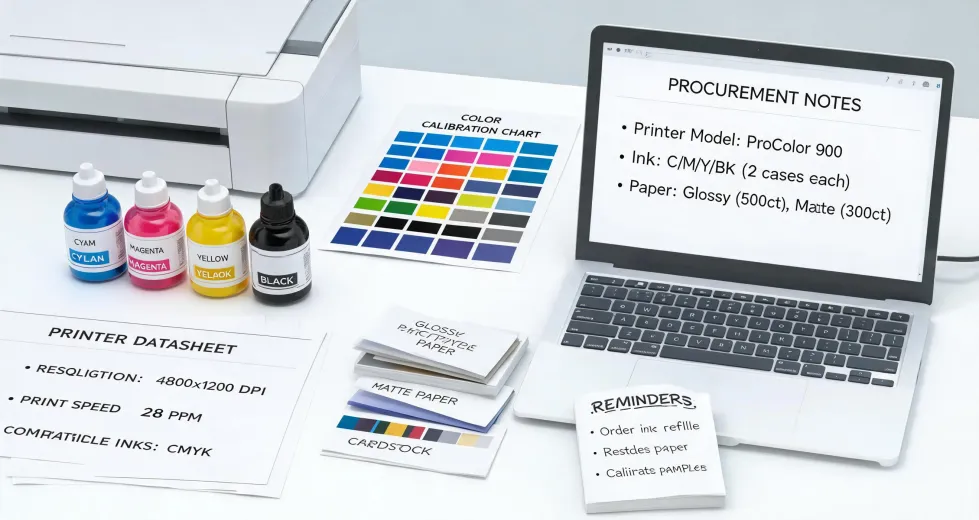
I manage office purchasing for a 400-person company, and I handle orders across about eight vendors. I report to both operations and finance, which means I get blamed twice when something goes wrong. After four years of this job, I'm convinced that buying an office printer by sticker price is a mistake. Stop comparing purchase prices. Start comparing total cost of ownership.
The most frustrating part of printer purchasing is that everyone assumes the number in the corner of the quote is the only number. It isn't. A vendor once gave us an attractive price on a printer, and it cost more in ink within six months than the printer itself. That experience changed how I evaluate every piece of office equipment.
Sticker Price Is Not the Real Price
Here's the formula I use: TCO = purchase price + consumables + paper waste + maintenance + labor + downtime + disposal. Too many purchasing conversations stop after the first variable. That's where the mistake happens.
For a typical office Epson printer, the consumable cost is the biggest hidden variable. An Epson EcoTank model like the ET-2803 is usually listed between $200 and $250 on U.S. retail sites as of January 2025. A set of replacement ink bottles for the EcoTank series can cost around $50 to $60 and print thousands of pages, based on Epson's published yield estimates. A cartridge printer in the same class might cost less upfront but use cartridges that run $40 to $60 for many fewer pages. You don't need an accountant to see which one wins at volume.
My position is not that Epson is the only brand that ever makes sense. The argument is that the visible price is a small part of the real price. If another brand has a similarly transparent cost-per-page model, I'll evaluate it. I just won't decide based on the first invoice.
Why I Made EcoTank Our Default Office Printer
When I took over purchasing in 2020, we replaced twelve cartridge-based printers with eight EcoTank units over the next year. Our annual ink expense dropped by more than half for the same print volume. That's not a flex. That's what happens when the cost model is designed around volume instead of constant replacement.
I also like predictability. A cartridge device runs out at the worst possible time. With EcoTank, the tanks are transparent and I can physically see the ink level. I don't need a supply emergency to be the reason a deadline gets missed.
How to check ink levels on an Epson printer
If you've typed “how to check ink levels on epson printer” into a search engine, you're already on the right track. Here's the routine I use on our units:
- Check the printer display. Most EcoTank models show a tank icon on the home screen. Select it to see approximate ink levels.
- On Windows, open Printers & Devices, right-click the Epson printer, choose Printing Preferences, then look for the Epson Status Monitor tab.
- On a Mac, open System Preferences, select Printers & Scanners, choose the printer, click Options & Supplies, then Utility and Open Printer Utility. The status monitor should appear.
- Use the Epson Smart Panel mobile app if the printer is on your network. It shows ink levels without walking to the printer.
Why is this a TCO topic? Because checking takes about thirty seconds. An avoidable out-of-ink event can cost more in delayed work than the bottle itself. The habit is part of the system.
The Hidden Costs That Don't Appear on Any Quote
Three hidden costs shaped my opinion more than any spec sheet.
Labor
Every interruption, even a small one, breaks someone's focus. If you load your admin staff at $35 per hour, a five-minute printer issue costs about $3. That sounds small. But multiply it by ten interruptions a week across three locations, and it becomes real hours. EcoTank refills are cleaner and less frequent, so the interruption cost drops too.
Downtime
Then there's downtime. The cost of a missed finalist deadline never appears on an invoice. But the delay changes how the whole office sees the procurement function. I'm not saying printers fail every day. I'm saying availability has to be built into the purchase decision.
Repair and Replacement Decisions
Printers are not all equally serviceable. Some low-end printers have repair bills that make no sense after a year. I've been in the position of choosing between a $120 repair on a $200 printer and replacing the whole unit. The TCO model helped me avoid the sunk-cost trap. A printer that's out of warranty and unreliable is not a bargain.
About the Epson ET 2803 as a sublimation printer
I need to pause on the search term “epson et 2803 sublimation printer.” It's everywhere, and I understand why. The ET-2803 is a low-cost EcoTank model, so people wonder if it can double as a dye-sublimation printer for mugs or T-shirts.
My understanding is that the ET-2803 is not sold by Epson as a dedicated dye-sublimation printer. Epson has a separate series for that type of work. Can someone convert it to use sublimation ink? Probably. But that's a hobby experiment, not a purchasing plan.
The upside is a low-cost way to test a craft idea. The risk is color inconsistency, wasted media, and a voided warranty. I kept asking myself: is the saving worth the risk? For a business, my answer is no. If a vendor advertises the ET-2803 as a sublimation printer, ask what happens if the printhead fails and whether Epson covers conversion use. Silence is a red flag.
The Same Logic Explains the Acrylic Paint Question
Someone in our office once asked “can you use acrylic paint on fabric?” The short answer is yes, with the right medium. But that doesn't make acrylic paint a printing method. Painted fabric has a different feel, durability, and wash behavior than fabric printed with dye-sublimation or pigment ink.
If you need one custom shirt, painting might be cheaper. If you need repeatable results, use the right tool. That's TCO thinking outside the printer aisle.
Use Calculators, But Don't Worship Them
This is also where calculators come in.
In a previous vendor review, I put all our printer repair tickets into a mean median mode calculator. The mean repair cost was alarming. But the median and mode were both $0 because most printers didn't break that year. One catastrophic failure had skewed the average. If I had used only the mean, I would have overpaid for maintenance. The median gave me a more realistic view of routine cost.
Similarly, someone who finds an “a1c calculator” is trying to translate a lab result into something understandable. A TCO model does the same thing. It converts scattered expenses into one number. That's useful, but it's still a model. Garbage assumptions produce garbage estimates.
You don't need a calculator to find the biggest line item. The biggest line item is usually the one we ignore because it shows up in someone else's budget.
My Position After Four Years
If you want my opinion, here it is: Don't buy a printer. Buy the cost structure that lets you print without drama. For our office, that has meant more Epson EcoTank printers. For your business, it might mean something different.
Start by asking how you'll check ink levels, what consumables cost at your actual print volume, and who will handle the printer after the warranty expires. Those questions are more useful than any coupon code. And if you still want to argue that the cheap machine is cheaper, bring the whole cost sheet. Not just the first invoice.
This article reflects my experience as of January 2025. Pricing and product availability change quickly, so verify current details on Epson's official support site before making a purchase.
