
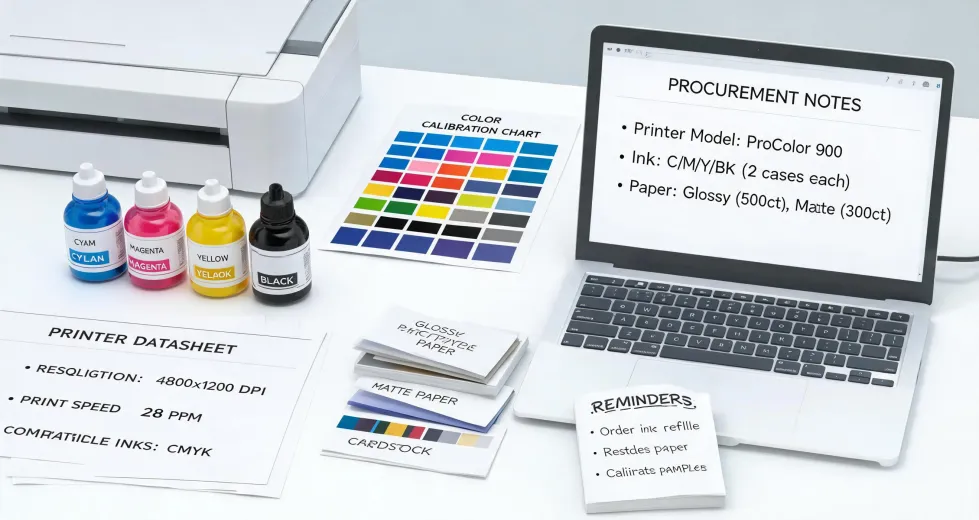
Last July, I was sitting on the floor of our storage room with three dead printers around me. One had a paper jam that had become a permanent state of being. Another was making a noise I can only describe as a dying robot. The third had just flashed a message that said 'replace ink cartridges' for the fourth time that quarter. My boss stood in the doorway and asked the question every procurement manager dreads: 'Why is printing such a black hole?'
I didn't have a good answer. I've been the procurement manager at a 30-person creative agency for six years, and I've tracked every ink cartridge, ream of paper, and repair invoice in our cost system. But I still didn't know the actual cost per print. That moment—and the three months of spreadsheet work that followed—changed how I buy printers, paper, and even art supplies.
The Wrong Question I Used to Ask
When I first started managing office equipment, I assumed the lowest upfront price was the smartest purchase. I thought a printer was a printer. That assumption cost us a lot of money over the years.
The first thing I had to unlearn: a printer is not the product. The ink, paper, maintenance, and wasted hours are the product. The printer is just the delivery system. It took me six years and about 180 separate orders to understand that. The irony is that I'd been doing total cost of ownership for every other vendor, but printers got a pass because they seemed familiar.
Recently, someone in a procurement forum asked, 'epson or hp printer which is better'—and the only honest answer is, 'It depends on your cost structure.' I used to give that answer too, but I didn't really mean it. Now I mean it.
The Spreadsheet That Changed My Mind
In August, I started a formal printer fleet review. I pulled quotes from four vendors. One was Epson, one was HP, and the other two were brands we'd used before. I'm not going to say every Epson beats every HP. That's not true. But for our specific environment—a busy creative agency that prints design proofs, client presentations, and the occasional 200-page deck—the math came out clearly.
Here's what I learned: the cheapest quote was not the cheapest printer. One vendor offered a lower hardware price, but the setup fee, first-year supply bundle, and mandatory service contract added up to $1,200 in costs that weren't visible in the headline number. When I added those to the per-page ink cost, the 'cheap' printer was about 18% more expensive over 24 months.
At first, I wasn't looking for an Epson printer specifically. I was looking for a lower total cost of ownership. The Epson EcoTank line won because the ink bottle system changed the math. It doesn't make sense for a low-volume office, but for us, one set of bottles lasted over a year. We went from buying cartridges every 5 weeks to buying bottles twice a year. The cost per page dropped by about 60% in our tracking.
I built a TCO model in our procurement system. I included hardware, ink, paper, repairs, energy, and the estimated labor cost of dealing with jams. At one point I pulled out a scientific notation calculator to keep decimal places straight when I was converting per-page costs into annual projections. That might sound dramatic, but when you're forecasting 14,000 pages per month, a two-cent difference per page becomes more than $3,300 a year.
Color, Paper, and the Art Supply Hunt
Of course, cost per page isn't the only number. Our design team has to match client-brand colors. One of our designers asked me where to find cheap art supplies, and I told her the cheapest supply is the one that doesn't get rejected because the color is wrong. Paper is a good example. Standard copy paper is 20 lb bond, about 75 gsm. For client presentations, we use 24 lb bond, about 90 gsm. It's a few more dollars per ream, but it holds ink better and feels professional. The spec sheet can't tell you that; the hand can.
Color was where Epson's photo and proofing background showed up. Before this project, I didn't know what Delta E was. Now I can tell you the Pantone Color Matching System guidelines say brand-critical colors should be Delta E less than 2. A Delta E of 2 to 4 is noticeable to trained observers, and above 4 is visible to most people. For one client's logo, the designers wanted Pantone 286 C, a common corporate blue. Pantone 286 C doesn't have an exact CMYK equivalent; the printed result depends on the printer, paper, and calibration. Our Epson, with a custom ICC profile, hit the target within tolerance. The HP we evaluated did not, at least not without a lot of extra fiddling. That doesn't make HP bad. It makes it the wrong tool for that job. I've recommended HP to small businesses before, and I still would.
Also, for anyone wondering: standard commercial print should be 300 DPI at final size. A 3000 by 2000 pixel image at 300 DPI will print at a maximum of 10 inches by 6.67 inches. If you need bigger, you either lower the DPI or increase the source resolution. This matters more than the brand name on the front of the printer.
The F 570 Sublimation Plot Twist
In Q2 2024, a client asked us to produce branded mugs for a product launch. We didn't own a sublimation printer. We considered outsourcing, but the timeline was tight and the client wanted three revisions before approving. So we added an Epson F 570 sublimation printer to the fleet. It was a different beast from the office EcoTank printers.
I almost made a classic mistake: I assumed sublimation was just inkjet printing with special ink. It's not. The F 570 prints a mirror image onto transfer paper, and then heat and pressure move the dye into the coating of the mug. I watched our production person do four test runs before she got the color density right. The lesson: with sublimation, you're not just managing a printer, you're managing a workflow.
The same week, our product team asked about a resin 3D printer for small prototypes. I had to stop them and say that's a different cost model entirely. Resin printers involve consumables, wash stations, ventilation, and toxic waste disposal. You can't apply the same cost-per-page logic. If they had asked me two years earlier, I probably would have lumped it into the same budget and hoped for the best. That would have been a mess.
The Result: $8,400 a Year, and Some Peace
After three months of testing, we switched our main office fleet to Epson EcoTank printers. We kept one HP laser printer for the rare case where a true monochrome laser is the right tool. We signed the order in November 2024. As of January 2025, our cost-per-page tracking still shows the same 60% reduction. The annual savings came out to about $8,400—roughly 17% of our print budget. Not bad for a project that started with three dead printers and one frustrated boss.
There's something satisfying about a print fleet that just works. After six years of midnight cartridge swaps and 'printer not responding' conference calls, the best part isn't the savings. It's the silence. The printers are there, they print, and nobody thinks about them. That's the real win.
What I'd Tell a Friend (or a Procurement Forum)
If someone asks 'Epson or HP, which is better?' I now say: tell me your pages per month, your average ink coverage, your color tolerance, and your labor cost for a jam. Then we can talk.
Here are the lessons I'd pass along:
- Calculate total cost of ownership before you compare models. The sticker price is the beginning, not the answer.
- Get quotes in writing, and ask what's not included. 'Free setup' often means something else is paid for elsewhere.
- Let a designer do a test print on the actual paper you use. The brand name doesn't matter if the color is off.
- Don't treat sublimation and resin 3D printing like ordinary inkjet printing. They have different consumables, different safety requirements, and different hidden costs.
What was best practice in 2020 may not apply in 2025. Ink tank printers changed the economics. Color standards haven't changed, but the tools for hitting them have. And the fundamentals haven't changed either: track the real costs, ask the real questions, and don't trust a headline number.
Ask not 'which printer is better.' Ask 'which printer is better for this specific workload and cost structure.'
If you're in the middle of your own printer drama, start with the data. It's boring, but it works. And maybe keep a scientific notation calculator on your desk. You'll probably need it.
